


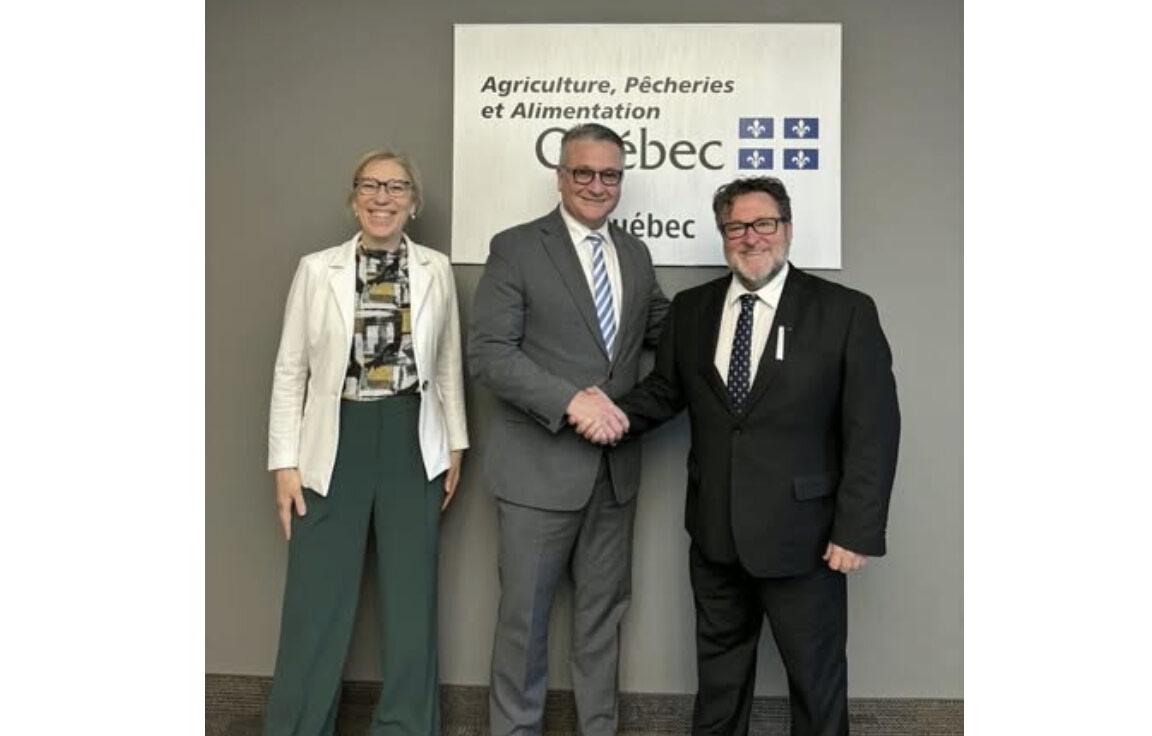
At the UPA General Congress, MP Sophie Chatel, alongside Federal Agriculture Minister Heath MacDonald and Quebec’s Minister of Agriculture Donald Martel, met to discuss Quebec’s agricultural priorities, with a shared focus on creating a stable, equitable, and efficient commercial environment to support farmers and strengthen food sovereignty. Photo: Courtesy
UPA conference puts spotlight on local resilience
Tashi Farmilo
Quebec’s agriculture sector entered a defining conversation last month as over 1,000 producers, policymakers, and stakeholders gathered at the Union des producteurs agricoles (UPA) General Congress in Quebec City. Framed by economic pressure, climate instability, and shifting trade realities, the three-day event underscored both the fragility and strategic importance of local food systems. For Sophie Chatel, Member of Parliament for Pontiac Kitigan Zibi and Parliamentary Secretary to the Minister of Agriculture and Agri-Food, the Congress reflected the urgency to act on what farmers already know from experience.
The UPA Congress, held December 2 to 4 under the theme “United for the Future,” was marked by calls for renewed commitment to domestic food procurement, streamlined regulations, and consistent government policy. Chatel, who addressed delegates and introduced the federal Minister of Agriculture, used her presence to emphasize the economic and strategic weight of the agri-food sector. “It’s the largest manufacturing sector in Canada,” she said. “We often talk about automobile, for example. Agri-food is so much bigger. It represents 7.2 per cent of our GDP and one in every nine jobs.”
Chatel and Federal Agriculture Minister Heath MacDonald also met with Quebec’s Minister of Agriculture, Donald Martel, during the conference. They discussed provincial priorities and how federal and provincial cooperation could help realize them. “Ensuring a stable, equitable, predictable and efficient commercial space is essential to the prosperity of our farmers and our food sovereignty,” Chatel said, echoing MacDonald’s remarks.
Beyond policy, Chatel focused on climate adaptation as a top priority. She highlighted the $38 million Agricultural Climate Solutions program, administered through the UPA, as an essential tool to support practical resilience strategies on farms. Techniques supported by the program include improved soil management and cover cropping to retain water in drought conditions. “That is the kind of practical, farm-level innovation we need to see across the country,” she said.
She also raised concerns about the hidden impacts of international trade policy on Canadian agriculture, especially as they relate to packaging and food production costs. While agricultural products themselves may not always be subject to tariffs, the materials needed to process and sell them such as aluminium and steel for cans or wood for packaging often are. “Although tariffs do not impact food directly, they hit packaging. That drives up grocery prices. It’s all connected,” she said.
As a response to this growing pressure, Chatel pointed to Ideal Can, a Quebec-based can manufacturing company that is investing in expanded operations in Ontario. Historically, much of Quebec’s canned vegetable production has relied on a circular supply chain in which crops such as tomatoes grown in Ontario are sent to the United States for canning before being imported back into Canada for sale. This cross-border dependency, while once cost-effective, has become increasingly expensive due to American tariffs on imported Canadian aluminium and steel. U.S. manufacturers facing these tariffs pass the added cost onto Canadian food companies, which in turn contributes to higher retail food prices.
By investing in domestic canning infrastructure, Ideal Can aims to shorten and localize the supply chain, insulating producers from foreign tariff regimes and keeping more of the value-added production process within Canada. “They now have a competitive product because the U.S. cans are tariffed,” Chatel explained. “And if we’re supplying the aluminium, we might as well supply it to ourselves.”
The case of Ideal Can illustrates a broader trend toward rethinking food sovereignty, not just in terms of growing food locally, but also processing, packaging, and distributing it without relying on vulnerable global supply chains. For rural economies like the Pontiac’s, the ripple effects of these upstream shifts are real. More local canning capacity means more stable demand for regional produce, more predictable pricing, and potentially lower costs for consumers.
Chatel emphasized that policy must work in tandem with industry leadership to strengthen domestic resilience. “We need to make sure that when Ottawa talks about food security or innovation, it means something real on a farm in Mansfield or Otter Lake,” she said.
The UPA Congress also brought renewed attention to regulatory and institutional reforms. UPA President Martin Caron urged the government to set clearer targets for food procurement, invest in farmland protection, and lower the cost of agricultural credit. With federal and provincial agreements on agriculture programming up for renegotiation this year, 2026 is set to be a critical moment for shaping the province’s farming future.
For rural regions like the Pontiac and the broader Outaouais, these decisions matter not only for local economies but for long-term food security and cultural continuity. “Farmers are on the front lines of everything. Climate, markets, food prices,” Chatel said. “We can’t afford to leave them behind. And they’re telling us, clearly, that they need us to show up.”