


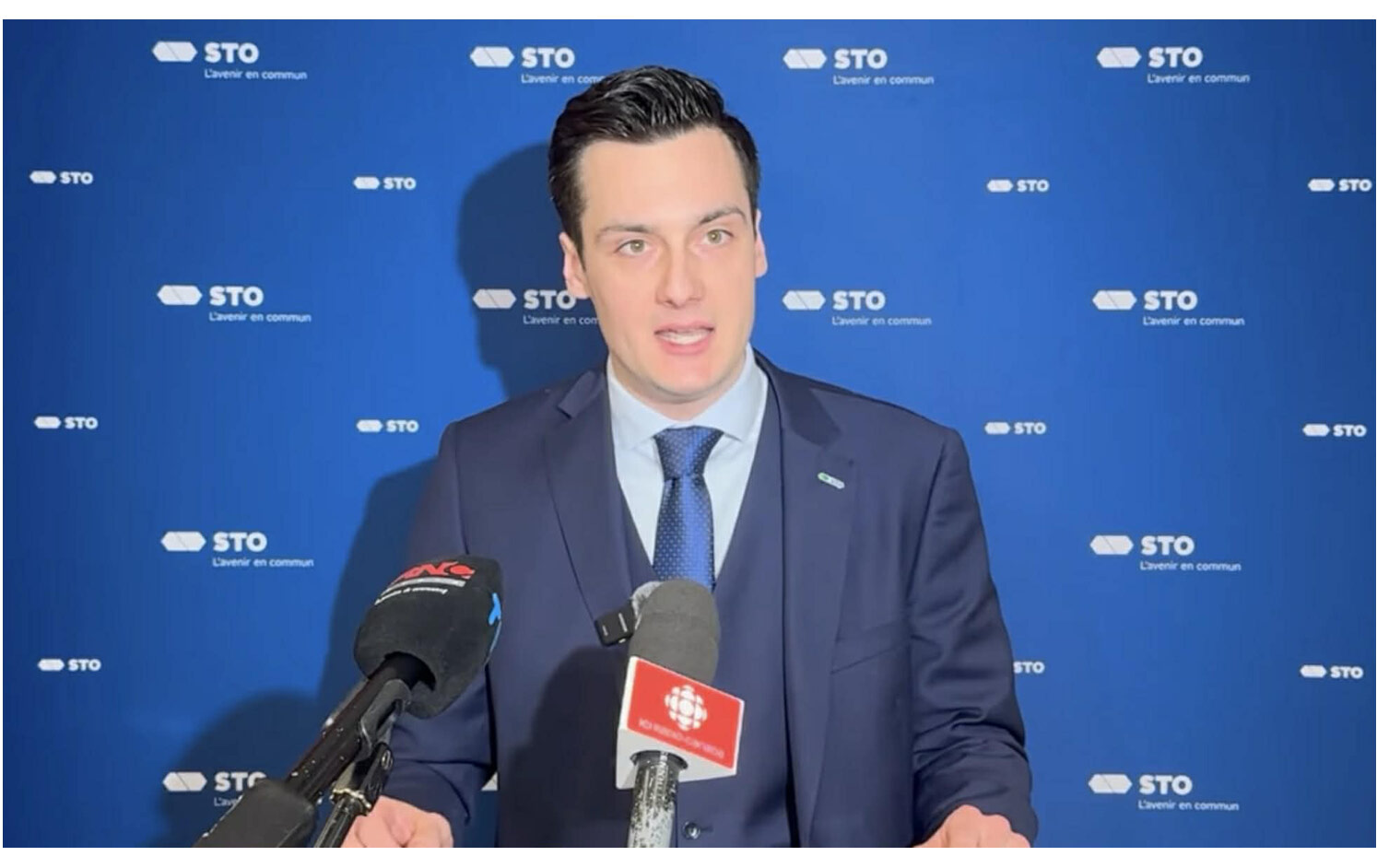
Edmond Leclerc during the February 26 press conference on provincial funding cuts to the STO. Photo: Screenshot
STO projects halted as Quebec announces more funding cuts totaling $205 million
Sophie Demers
Société de transport de l’Outaouais (STO)’s Board of Directors president Edmond Leclerc announced that the province of Quebec will withdraw investments from the region’s Public Transit Capital Plan totalling $205 million. This news comes weeks after the province's decision to withdraw funding for the tramway and dismantle the project office with the STO. The total includes the funds withdrawn from the tramway planning budget, which represents approximately half of the total.
The money will be withdrawn over the next five years starting with the first $50 million in 2026. Leclerc says this will affect many projects and plans such as the purchase of 20 electric buses planned for next year as well as the plan to extend the Rapibus to Boulevard de l'Aéroport. Edmond says, as it stands, these projects are not possible without the province's funding.
“Honestly, I don't know what message to send to the Government of Quebec, except that they must stop defunding us, especially the amounts that have already been promised to us,” said Leclerc during a press conference at the end of February. “This is now affecting the basic STO services, namely bus financing. This is a very frustrating situation, which is also shared by my colleagues who are presidents of other public transportation organizations everywhere in Quebec.”
Large projects and purchases such as buying electric buses in 2027 or the planned extension of the Rapibus system take years to plan, finance, order equipment, and receive necessary materials. Therefore, cuts of this magnitude will affect the ability for STO to complete these projects for years to come. The STO bus fleet is aging; the cuts impede the organization's ability to upgrade equipment and their aging bus fleet.
“We no longer know which solution to turn to, honestly. It takes a government that believes in public transport, and then, currently, it is not the case, and it will force us to make decisions that will not be easy,” said Leclerc.
Leclerc also raised concerns about the costs of the STO, which is financed by a variety of revenue streams such as bus users, as well as city and provincial funding. “Collective transport operations are also defunded by the Quebec government. So, that's also an issue.”
Looking to the future, Leclerc says there are no concrete plans yet, as the STO is gathering information about the cuts, but all scenarios must be considered. “Hypothetically, if the STO had to reduce services, review the quality of services because it no longer has the means, that would have a direct impact on passenger revenues because they use it when the service is good.”