


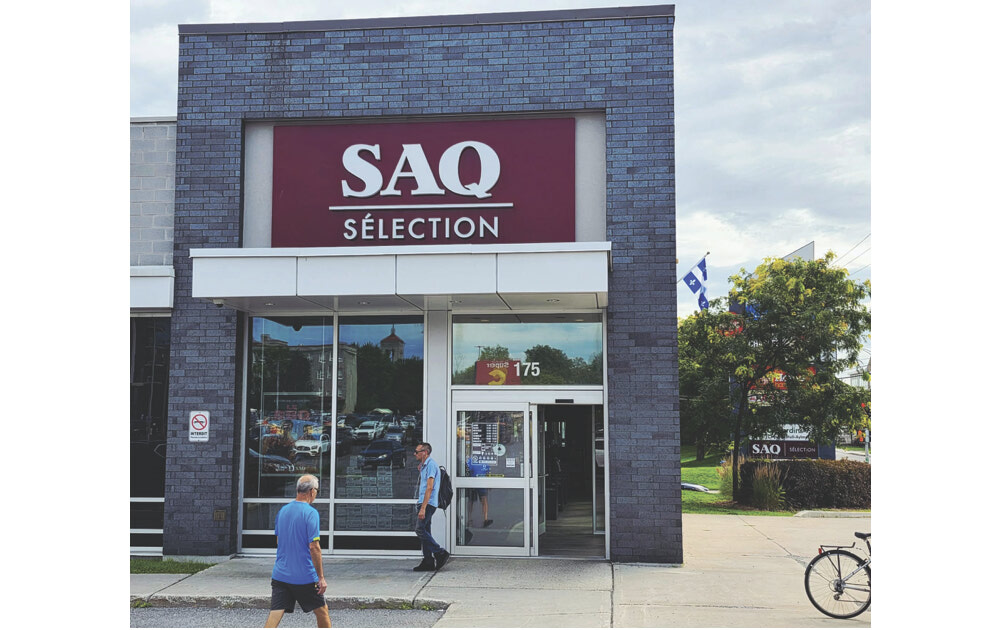
Quebec Premier Christine Fréchette says she is open to returning U.S. wines to Société des alcools du Québec shelves if Washington eases tariffs on key provincial industries, even as her government holds off on a national deal that would let producers from other Canadian provinces sell directly to Quebec drinkers. Photo: Tashi Farmilo
Quebec courts US wine while Canadian producers still wait at its border
Tashi Farmilo
Quebec Premier Christine Fréchette said on August 10 in Yamachiche that she would welcome American wines back into provincial liquor stores if Washington eased tariffs on Quebec forestry, aluminum, and manufacturing, even though her government has not yet extended the same access to producers in other Canadian provinces. The contrast is hard to miss: a province ready to bargain retail space to a foreign capital it spent the past year punishing, while brewers and distillers one provincial line away stay locked out.
Quebec instructed its liquor agency, the Société des alcools du Québec, to strip American products from its stores on March 4, 2025, after an earlier tariff round from President Donald Trump's administration. Fréchette is now hinting those bottles could come back, though only in exchange for concessions at the bargaining table. Her office has insisted the ban stays until Quebec judges a trade deal fair, and that the decision belongs to the province alone. She held firm on other fronts as well, ruling out any arrangement that would erode the province's farm supply management rules or weaken its French-language and cultural protections. Her room to manoeuvre is narrowing. Another wave of 50 per cent U.S. tariffs takes hold August 19, with no relief for goods that satisfy the Canada-U.S.-Mexico trade pact, and Trump has pointed directly to Quebec's liquor ban in justifying the levies.
Her readiness to negotiate with Washington sits awkwardly beside her handling of Quebec's own neighbours. Nine provinces struck a deal on July 21 to dismantle obstacles to alcohol sales between provinces, clearing the way for breweries and distilleries to ship straight to customers in other jurisdictions. Quebec stayed out, joined only by the Yukon, the Northwest Territories, and Nunavut. The reason Fréchette gives is procedural: she says the province backs the goal, but the National Assembly must reconvene and rewrite several provincial statutes before Quebec can take part. The territories cited their own particular circumstances, while Quebec is described as having helped shape the agreement's terms with an eye to joining later.
There may be more to the hesitation than paperwork. Frédéric Laurin, an economist at the Université du Québec à Trois-Rivières, told CBC News and Radio-Canada in July that Quebec might be wary because direct-to-consumer sales could offer a way around the SAQ's monopoly. The state retailer collects a significant markup on the alcohol it sells, and Laurin said it remains unclear how that revenue would be handled under the new arrangement, asking who would collect any surcharge and whether it would fall to the province where a product is made or the one where it is bought. He added that Quebec is likely weighing technical, financial, and legal questions, including its obligations under international trade rules, noting that foreign wineries could argue for the same treatment extended to Canadian producers. Whatever the mix of motives, the outcome on the ground is unchanged for a distiller in Ontario or a vintner in Nova Scotia: neither can sell straight to Quebec drinkers, while a winemaker in California may soon regain that very route.
Canadian producers have waited a long stretch for such an opening. The agreement traces back to a 2025 memorandum endorsed by every province and the Yukon, one piece of a broader push to shore up domestic commerce as American tariffs mounted. New Brunswick and Manitoba had already scrapped their own restrictions before the summer announcement. Wine Growers Canada, which spent close to two decades pressing for the change, welcomed the deal as a milestone toward a countrywide market for Canadian wine. Quebec stands out as the notable holdout, further along in its talks about foreign wine than in its commitments to homegrown labels.