Home Contact Sitemap login Checkout


Bulletin d'Aylmer
  • Home
  • Local FR
    • Local FR
    • Vivre en santé
    • Provincial
    • Conseil
      • Conseil
      • Élection partielle 2024
    • Les chiens d'Aylmer
  • Opinions
    • Opinions
    • Lettres à l'éditrice
    • Éditoriaux
    • Chroniques
  • Soumettre une lettre à l’éditrice
  • Événements
    • Événements
    • Soumettre des photos
    • Photo Submissions
    • Le Meilleur d'Aylmer
      • Le Meilleur d'Aylmer
      • Galerie de photos 2024
      • Galerie de photos 2022
      • Galerie de vidéos 2022
      • Galerie de photos 2018
      • Galerie de photos 2017
      • Galerie de photos 2016
      • Galerie de photos 2015
      • Galerie de photos 2014
      • Galerie de photos 2013
      • Galerie de photos 2012
  • Annonces classées
  • Répertoire
  • Coordonnées
    • Coordonnées
    • Équipe administrative
    • Abonnements
      • Abonnements
      • Modifiez votre abonnement
    • Équipe éditoriale
    • Équipe de publicité
    • Équipe de production
    • Équipe de distribution
    • À propos
  • Local EN
    • Local EN
    • Healthy Living
    • Provincial
      • Provincial
      • News from across Quebec
    • Council
      • Council
      • 2024 mayoral by-election
    • Dogs of Aylmer
  • Opinion
    • Opinion
    • Editorials
    • Columns
    • Letters to the Editor
  • Submit a Letter to the Editor
  • Events
    • Events
    • Best of Aylmer
      • Best of Aylmer
      • 2024 Photo Gallery
      • 2022 Photo Gallery
      • 2018 Photo Gallery
      • 2017 Photo Gallery
      • 2016 Photo Gallery
      • 2015 Photo Gallery
      • 2014 Photo Gallery
      • 2013 Photo Gallery
      • 2012 Photo Gallery
  • Classified Ads
  • Directory
  • Contact
    • Contact
    • Subscriptions
      • Subscriptions
      • Adjust your Subscription
    • Editorial Team
    • Advertising Team
    • Production Team
    • Administration Team
    • Distribution Team
    • About
    • Outaouais Newspaper App
Print This Page

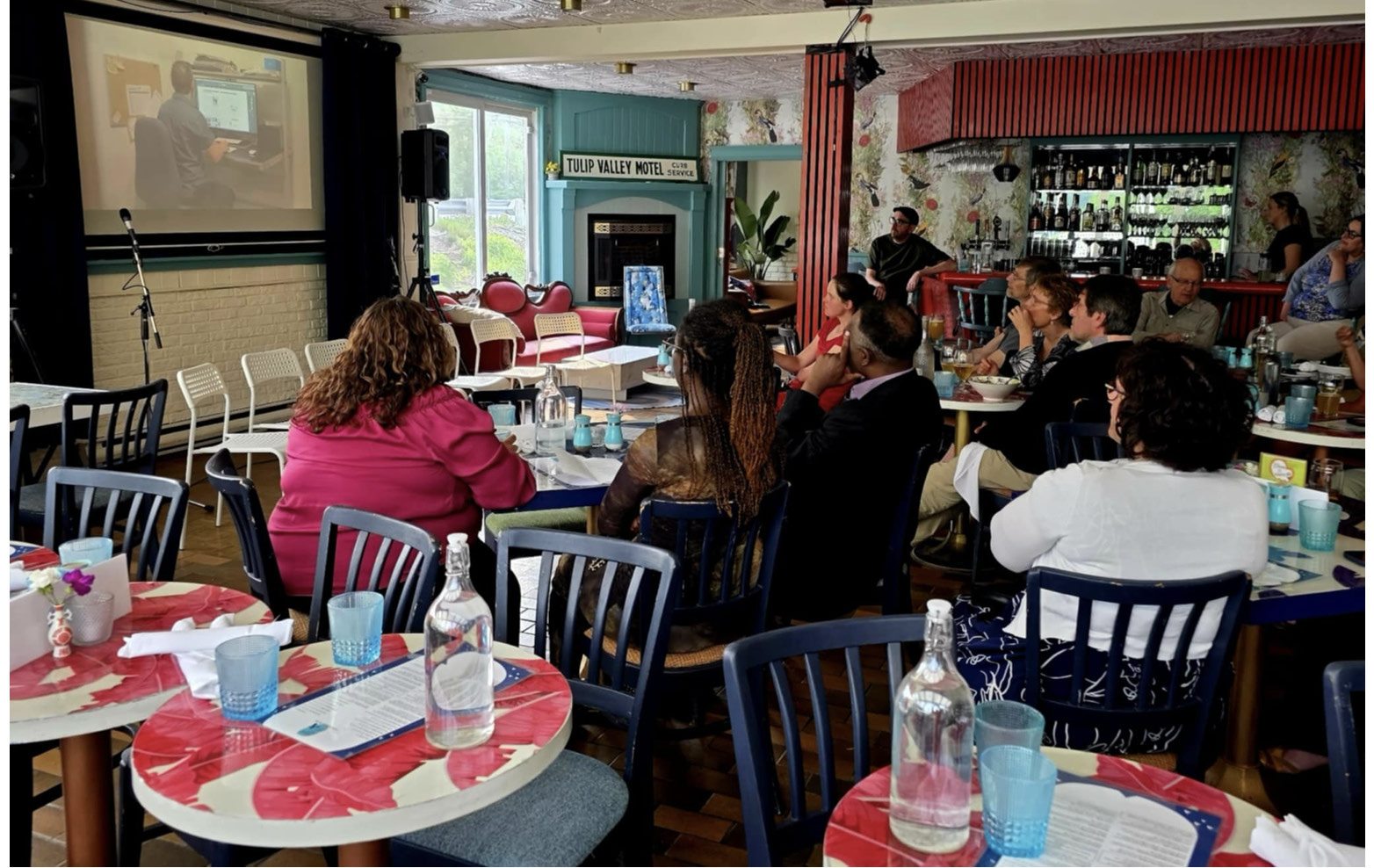
Audience members watched attentively as Regional Realities: Outaouais unfolded on screen, highlighting the challenges English speakers face and the hopes they hold for a more inclusive future. Photo: Tashi Farmilo


Outaouais anglophones on identity, belonging, and the future


Tashi Farmilo


A new documentary exploring the experiences of English-speaking Quebecers in the Outaouais premiered at Motel Chelsea on June 6, drawing a small but attentive crowd, both anglophone and francophone. Regional Realities: Outaouais, directed by filmmaker and QUESCREN research associate Anita Aloisio, is the first in a new series of short documentaries produced by the Quebec English-Speaking Communities Research Network (QUESCREN), based at Concordia University. The film is part of a broader effort to document how language, identity, and place intersect for English-speaking communities across Quebec.


The 30-minute film features voices from across the region, including Low Down to Hull & Back News publisher Nikki Mantel and editor-in-chief Trevor Greenway, Connexions Resource Centre executive director Danielle Lanyi, Greg Graham, a farmer and literacy advocate, Paul Tonkin, executive director of Outaouais Wellness Learning (OWL), and Judith Anne King Matheson, a local elder affiliated with White Owl Outaouais Wellness Learning Wisdom. These individuals spoke from within their communities, reflecting on access to health care, shrinking English-language services, the impact of legislation like Bill 96, and the strain of navigating bureaucratic systems that do not always account for linguistic minorities.


In one scene, Greg Graham describes the Pontiac as “at the bottom of the bottle,” pointing to decades of underinvestment in rural health care and services. The film also addresses growing anxiety among anglophone students facing new requirements like the mandatory French Exit Exam to graduate from CEGEP. Participants spoke of the cumulative effect of language legislation—particularly Bills 96 and 101—on daily life, from restrictions on English schooling to barriers in accessing public services. Under Quebec’s language laws, only those with a Certificate of Eligibility may attend English public schools, a rule that excludes most francophone and immigrant families and has left some mixed-language households unable to choose the school system they feel fits best. This is not a matter of preference but of legal restriction, one that many feel reduces flexibility and deepens linguistic division.


The film also highlights how the laws, though not explicitly banning English-language services in healthcare, have contributed to confusion and uneven application. Some medical professionals, citing the new legislation, have refused to serve patients in English—even when it remains legally permitted. For seniors who have lived their entire lives in English, this shift has been especially difficult. Many now find themselves unable to access basic services, from transportation to medical appointments, due to their limited French. Others spoke of no longer understanding municipal notices or being able to participate in public meetings, including something as routine as garbage collection instructions. The result, several participants suggested, is not simply inconvenience but a growing sense of exclusion in communities they have long called home.


After the screening, QUESCREN's Patrick Donovan moderated a discussion with Aloisio and several of the film’s participants. Audience members echoed the concerns raised in the film, speaking of service cutbacks, inconsistent access to information, and a growing unease about where English-speaking residents fit in Quebec’s evolving linguistic landscape.


Still, the evening was not defined by frustration alone. Many participants pointed to the resilience of their communities and voiced hope for the future. There was broad agreement that the next generation—raised in bilingual households, fluent in both languages—could help foster a more inclusive future. Several highlighted the role of technology, particularly translation tools, in reducing friction where policy lags behind. One speaker described the present moment as part of a broader shift, a time when communities are being asked to come together in new ways. Another called directly for equality, reminding the room that English-speaking Quebecers should not have to choose between remaining in their home province and accessing their basic rights.


Others referenced the Canadian Charter of Rights and Freedoms and Canada’s official bilingual status, emphasizing that French and English are to be treated with equal respect. While the reality on the ground often falls short of this principle, the film and the discussion underscored the importance of holding on to it—not just as a legal framework, but as a shared aspiration.


continue reading

Local EN
Council
Provincial
Opinion


Bulletin d’Aylmer

Contact & Subscription

Tél. 819-684-4755 ou / or 1-800-486-7678
Fax. 819-684-6428

Monday to Friday
from 9:00 am to 5:00 pm
Unit C10, 181 Principale, Secteur Aylmer, Gatineau,
Quebec, 
J9H 6A6


Advertise with us

819-684-4755

pub@bulletinaylmer.com


French

Locale
Conseil
Provinciale
Événements
Vivre en santé
Opinions
Papier Entier
Abonnements


English

Local
Council
Provincial
Events
Healthy Living
Opinion
Entire Paper
Subscriptions


Site Manners  |  Built on ShoutCMS


This project has been made possible by the Community Media Strategic Support Fund offered jointly by the Official Language Minority Community Media Consortium and the Government of Canada

Nous sommes membre de l'Association des journaux communautaires du Québec.
Financé, en partie, par le gouvernement du Québec
et le gouvernement du Canada .

En collaboration avec le ministère du Patrimoine canadien .

We are a member of the Quebec Community Newspaper Association. 

Funded, in part, by the Government of Quebec ,  the Government of Canada .
In cooperation with the Canadian Heritage department .

Aylmer Bulletin  |  Bulletin de Gatineau 
|  The West Quebec Post  |  Journal du Pontiac