


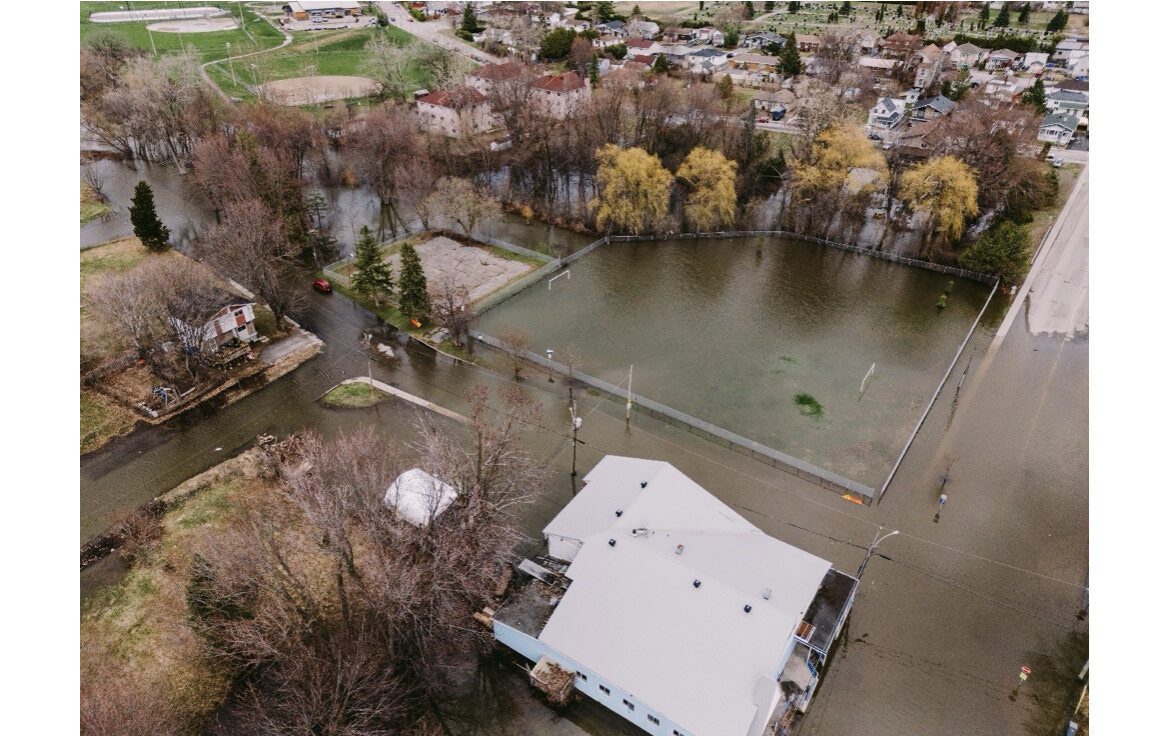
A national report on Canada's climate preparedness never mentions Gatineau or the Outaouais, even as spring floods keep returning to neighbourhoods like Pointe-Gatineau, an omission that traces back to Quebec holding the federal strategy at arm's length and leaving the region's defences split between governments. Photo: Courtesy of the City of Gatineau
Ottawa's climate report leaves the Outaouais out of the picture, even as Gatineau keeps flooding
Tashi Farmilo
A federal report on how well Canada is adapting to climate change never mentions Gatineau or the Outaouais, even as the region remains among Quebec's most flood-battered. Environment and Climate Change Canada released its 118-page 2026 National Adaptation Strategy Progress Report on August 13, the first update since the strategy launched in 2023, and the same day the Canadian Climate Institute called it evidence the country is not ready for the risks ahead.
The clearest reason is jurisdictional. The Quebec Ministry of the Environment, the Fight Against Climate Change, Wildlife and Parks told the Aylmer Bulletin the province does not consider itself bound by the federal strategy, on the grounds that most adaptation work, from land-use planning to public safety to infrastructure, falls under provincial jurisdiction. The position, the ministry said, avoids duplicating the two governments' efforts and protects Quebec's autonomy over its own territory. The province runs its own framework instead, the 2030 Plan for a Green Economy, drawing on organizations such as Ouranos. So the report Ottawa is holding up as its national scorecard is one Quebec has chosen to stand apart from.
That leaves Gatineau to plan for the water on its own terms. The City works under Quebec's flood framework and intends to adopt a flood-adaptation plan of its own in 2028. Asked where the Outaouais fits in the provincial picture, the ministry said mapping of the Ottawa River and several tributaries is already a government priority, and that a new $10-million measure in its 2026-2031 plan will help municipalities map flood zones not yet covered. It also pointed to Rénoclimat-Adaptation, a $425-million program to help homeowners adapt their houses to risks including flooding.
The stakes are not abstract. This past spring, Pointe-Gatineau flooded for the fourth time in a decade, as the Ottawa and Gatineau rivers rose in mid-April and peaked on April 22, just below the 2023 record. Water closed more than 40 streets, reached homes on rue Saint-Louis and rue Jacques-Cartier, and sent the City to open a Red Cross relief centre at its sports complex on boulevard de la Gappe before the waters receded in May. It was the latest chapter in a punishing pattern. The neighbourhood, one of Gatineau's oldest, was also swamped in 2017, 2019 and 2023, with more than 1,800 homes flooded across the city in 2017 alone. Faced with repeated disaster, Quebec began buying out homeowners in the worst-hit zones and barring rebuilding in the highest-risk floodplains; by late 2019, more than 185 owners had accepted buyouts and nearly 200 homes had been demolished, their lots transferred to the City for a symbolic dollar each.
Researchers have tracked what that exodus did to the neighbourhood. Nathalie St-Amour, a social work professor at the Université du Québec en Outaouais who studies flood recovery, has examined how Pointe-Gatineau's poorest and most isolated residents fared worst in the aftermath. In a 2024 master's thesis she supervised, graduate researcher Ariane Hamel documented how one of Gatineau's oldest neighbourhoods, hit again and again, went from a living community toward a deserted one. St-Amour, who co-directs Quebec's flood research network and sits on the City of Gatineau's scientific council, has publicly described the uneven toll as a form of environmental injustice; she did not respond to a request for comment by press time. The Climate Institute raises the same concern nationally, warning that vulnerable communities remain the most exposed and the least supported.
That criticism is the heart of the Institute's assessment. In a statement released the same day as the federal report, Ryan Ness, its director of adaptation research, argued Ottawa's report documents plenty of activity but little evidence any of it is reducing real risk, tracking programs rather than outcomes and painting what he called an "overly optimistic" picture. Nationally, the Institute noted, up to 1.5 million households face flood risk so severe they are effectively uninsurable, and only a third of Canadians have taken steps to prepare. Asked whether Quebec measures results differently, the ministry said progress is tracked through a public climate dashboard, while acknowledging new adaptation targets and indicators are still being developed.
Gatineau's flagship flood project puts that question to the test. The Wabassee Creek watershed program is funded by matching $22.51-million contributions from Ottawa and Quebec toward a total now estimated at $72 million. But the City was candid that the works manage summer and fall stormwater and will do nothing to stop the spring flooding driven by the Ottawa River freshet, the very flooding that has repeatedly devastated Pointe-Gatineau. And while prevention lowers long-term costs, it said, it is difficult to tie each dollar spent to a measurable drop in risk.
Water is not the only pressure. The City extends pool, beach and library hours during extreme heat, is expanding its urban forest and recently launched a stormwater grant program called EAULOGIK. Wildfire smoke, though it does not ignite in Gatineau itself, has fouled the region's air in recent summers, worst of all in June 2023, when smoke from Ontario and Quebec fires pushed the neighbouring Ottawa area's air quality to the top of Environment Canada's risk scale and among the worst readings in the world.
One Outaouais-adjacent item did surface in the federal announcement: $1 million for flood-reduction measures at the Mohawk community of Kanesatake, awarded through Ottawa's Local Leadership for Climate Adaptation program. That funding falls outside the Canada-Quebec arrangement, the province noted, because the community is under federal jurisdiction, a reminder of how many separate hands the region's climate response passes through.