


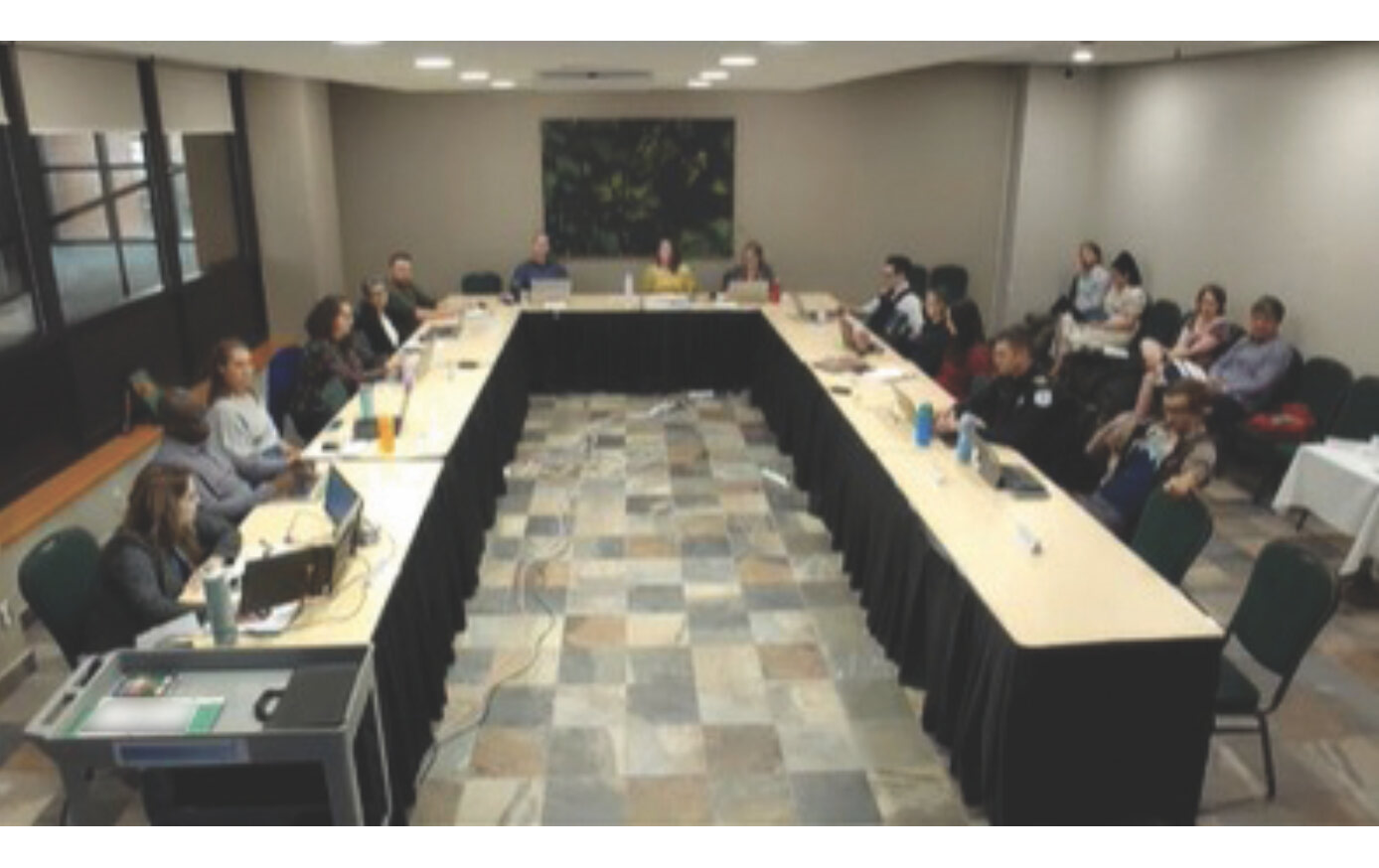
Gatineau’s transportation commission recommended on October 29 that the city bring back bike sharing under a publicly owned system run by an outside operator, while residents pressed for a pedestrian-focused mobility plan in the 2027 budget and staff updated members on the chemin Vanier redesign and a costly snow-clearing pilot on boulevard Montclair. Photo: Screenshot of the Commission on Transportation, Sustainable Mobility and Safety meeting of October 29 on YouTube
Gatineau commission backs return of shared bikes as pedestrians demand safer streets
Tashi Farmilo
Pedestrian safety, the future of chemin Vanier, the return of shared bikes and the cost of clearing snow from a bike lane filled the agenda of Gatineau’s Commission on Transportation, Sustainable Mobility and Safety on October 29 at the Maison du Citoyen in Hull. Commission members meeting in person and online made one formal decision: a recommendation that council bring back bike sharing under a publicly owned system run by an outside operator, to give residents another way to get around without a car.
The public question period opened with two residents who told the commission they are founding a group to defend pedestrians’ rights after recent deaths in the city. A 69-year-old Gatineau woman was killed at rue Gamelin and boulevard Moussette on August 31 and a 75-year-old woman died after being struck on boulevard Gréber on September 13. Another woman, 76, was killed on boulevard Fournier on October 23. Police recorded 25 collisions between vehicles and pedestrians over June, July and August, up from 19 in the same period of 2025.
The residents noted that Gatineau has plans for cycling and transit but nothing comparable for people on foot. They asked whether council would fund a citywide mobility plan in the 2027 budget, which council is studying now, whether the plan would put active and public transportation first, and whether residents would be consulted before drafting begins and again on a first version.
Commission chair Catherine Craig-St-Louis, the councillor for Carrefour-de-l’Hôpital, said she could not predict whether council will fund the plan, but she has made it her central priority and will keep defending it at council. According to the city’s mobility service, early work is under way, walking and cycling would hold an important place in the plan, and public consultations are planned. If council approves funding, work will begin in 2027 and could take about two years.
The commission then turned to the redesign of chemin Vanier in Aylmer, between chemin Pink and chemin d’Aylmer, which staff had presented to the public on October 28. City projections for 2046 show the central stretch, between boulevard du Plateau and chemin McConnell, carrying up to 1,200 vehicles an hour in each direction, far more than the rest of the road. Buses caught in congestion there already move at 5 to 10 km/h.
Under the concept, only the central stretch would be widened, to two traffic lanes plus one lane reserved for buses, carpools and taxis in each direction, with room for a possible future tramway. The northern and southern stretches would keep one lane each way. The whole corridor would gain sidewalks, raised one-way cycle tracks cleared in winter, lighting and accessible bus stops. Because the concept no longer calls for four lanes over more than 2 km, it is not subject to Quebec’s environmental impact assessment regulation, a change expected to save about two years and roughly $800,000. The project is now estimated at more than $93 million.
The intersection with boulevard des Allumettières remains the biggest unknown. It belongs to the Quebec transportation ministry, which has not announced its own design or timeline. Work on the chemin McConnell intersection is planned for next year.
Commissioners were divided on the widening, with one member warning that new lanes tend to attract more traffic and another asking whether widening the middle would encourage developers to expect the rest to follow. Staff said they want to avoid oversizing the road. A preferred option is expected this winter and the final study in the summer of 2027. Residents can attend an in-person workshop on November 10 at 7 pm at the Ernest-Lattion community centre or fill out the questionnaire on the city’s website until November 15.
The bike-share recommendation came next. Bike sharing works like a public fleet of bicycles parked at stations around the city. Users unlock a bike with an app or card, ride it for a short trip and return it to any station, paying per trip or through a membership. Under the model the commission favours, the city would own the bikes and stations, while a contracted operator would maintain the fleet, move bikes between stations and run the app.
The proposal grows out of a regional feasibility study led by Envirocentre, an Ottawa nonprofit, with Gatineau, Ottawa and other partners. The region’s last bike-share program closed in 2018. The study weighed city-run, paramunicipal and outside-operator models, the last being the arrangement Bixi uses in Montreal. Staff said the first two would require Gatineau and Ottawa to build a shared organization across a provincial border, while contracting out operations keeps public control of the system without that burden.
The recommendation calls for bikes docked at stations, a substantial share of electric bikes, spring-to-fall service at first and a large initial rollout. The study assumes about 300 bikes in Gatineau at roughly 30 stations. Ottawa staff have estimated launch costs at up to $10 million and pointed to a possible start in 2027 or 2028. The commission also asked council to confirm budgets and keep negotiating with Ottawa and the National Capital Commission toward a single regional system. The federal agency will not run a system again but is open to contributing money.
Follow-ups on several files closed the meeting. Under current rules, a driver who parks in the hatched zone beside an accessible parking space, which people with disabilities need to get in and out of their vehicles, faces a smaller fine than one who parks in the space itself. A bylaw amendment to make the two fines equal was introduced at council in October, with adoption expected in November.
Council also approved in October a cycling agreement with the Conférence des préfets de l’Outaouais to pool resources for a shared regional cycling vision. Rue Boudria in Hull will close to car traffic as a temporary school street beside École Jean-de-Brébeuf from November 9 to 13, so children can walk and bike to school more safely.
Craig-St-Louis then asked staff to explain a contract that has drawn public criticism. The city will pay nearly $275,000 to clear just over a kilometre of bike lane on boulevard Montclair this winter, or $548,392 if the contract is renewed for a second year, drawn from a $1 million fund for temporary cycling infrastructure.
Staff said most of the cost comes from hauling the snow away. On most busy streets, snow is pushed into the bike lane and removed only after 10 to 15 cm build up. On Montclair, the bike lane is cleared after every 5 cm, and the snow pushed into a narrow buffer must be trucked away the following night with specialized equipment, which is why the job was contracted out. The city will survey residents this winter before deciding whether to repeat the approach elsewhere, and a permanent separated bike path is planned for 2029.
Staff also announced that the city won two awards in this year’s Défi sans auto solo, a September challenge run across Quebec by the Réseau des centres d’expertise en mobilité and in the Outaouais by MOBI-O, which encourages employees to get to work without driving alone. Gatineau was named the top organization in the Outaouais across all sizes and took first place among large organizations.
The commission meets next on December 10.