


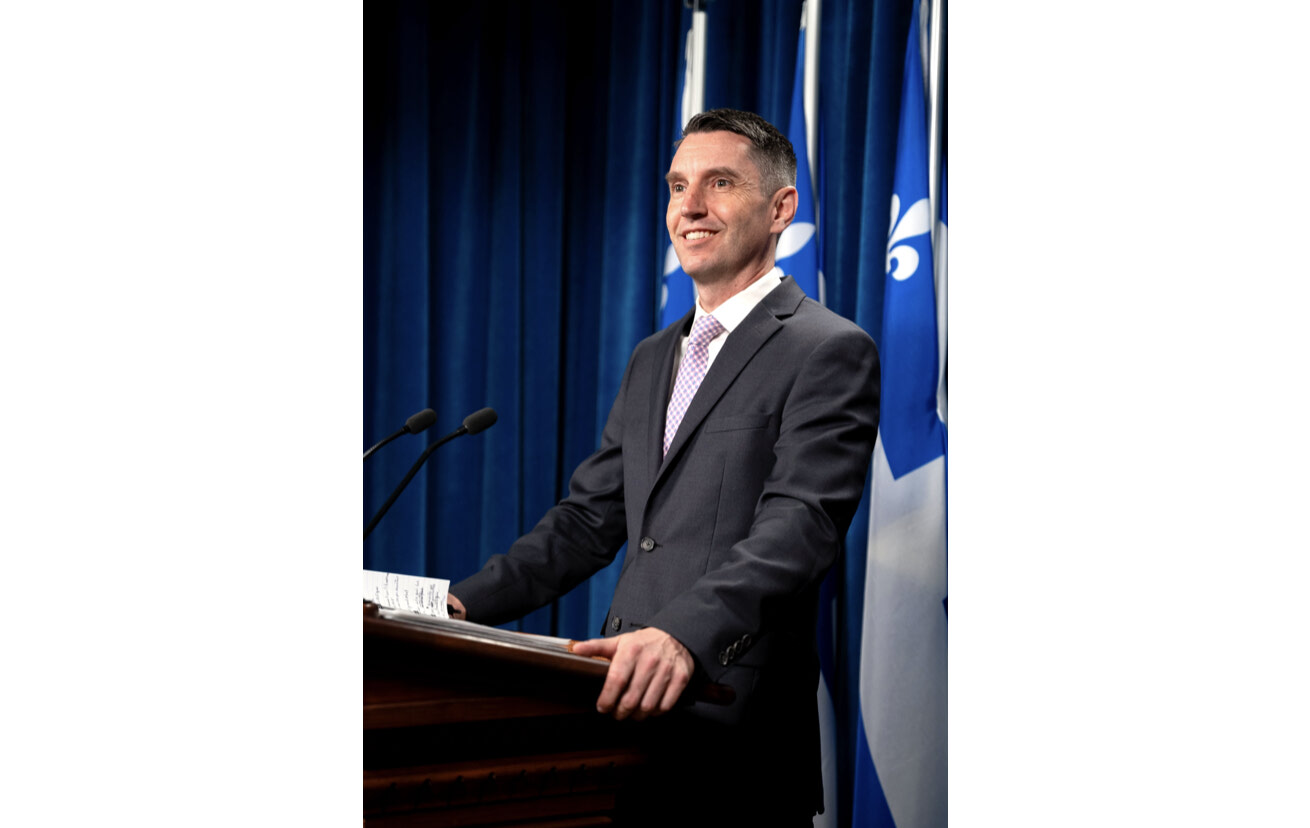
Pontiac MNA and Opposition leader André Fortin counts the wins and the shelved bills from a session cut short by a change of premier, and warns that the campaign ahead, with a possible PQ referendum at its centre, carries the highest stakes for this region. Photo: Courtesy
Fortin weighs the wins and losses of a session split in two
Tashi Farmilo
For André Fortin, the spring session at the National Assembly was defined less by what passed than by what was shelved, and by the fight he sees coming after it. The Pontiac MNA and Leader of the Official Opposition walked away from a sitting cut in two by a change of premier with a short list of wins, a longer list of measures set aside, and a warning that the coming election could weigh on this region more heavily than any law adopted this year.
The session that closed on June 12 was, by his own description, a strange one. A leadership race inside the governing Coalition Avenir Québec sent Christine Fréchette to the premier's office partway through, broke the calendar in half, and shelved a stack of bills before the government revived a handful for a compressed final stretch. "It was an odd session, because it was broken up," Fortin said. The rush that followed left little room to do the work properly. He said the study of the surviving bills was "probably quicker than we usually would do it," and while he accepted the pace where parties agreed, he would not accept speed for its own sake. "You don't want to adopt things without studying them," he said.
Not everything that stalled bothered him. "There are bills that we were happy to not see go ahead," he said, naming legislation he judged poorly planned and unfairly weighted against certain residents. The clearest win ran the other way. Bill 9, the new law barring the sale of caffeinated energy drinks to anyone under 16, passed in the session's final days with near-unanimous support. Named for Zachary Miron, the 15-year-old whose death after mixing an energy drink with his medication drove the push, it was the kind of file where the parties lined up together. "Where there's cross-party support, we managed to do it," Fortin said, though he noted the time crunch hanging over the whole stretch.
Other files ran out of time. A bill to fast-track approvals for projects deemed to be of national importance, Quebec's answer to the federal legislation passed in Ottawa last summer, was shelved after, in Fortin's account, one party dug in and slowed it down. He called that one a loss worth regretting.
He also flagged a habit the government broke. Where past CAQ majorities leaned on closure to force bills through, as with the language law Bill 96 and the secularism law Bill 21, this time several measures were left to lapse. Fortin reads strategy in the restraint. "I think they're pretty happy to have some bills just in the window for the election campaign," he said.
The measure he keeps coming back to is the bill that would have extended the Charter of the French Language to adult general education and vocational training, closing off English-language access for students outside the province's historic anglophone community. The government said it could affect tens of thousands of learners. Fortin says it punishes adults for deciding where they want to study. "It's adult education. So it's adults that we're talking about," he said. "We believe that adults should be able to choose their institution of education." People in those programs rarely follow a straight line, he argued, and an institution like the Western Quebec Career Centre is often the route that works. As he put it, "they do great things for a lot of people in our community," and shutting French-schooled adults out of it makes no sense to him. "If they think it's their best chance to succeed, they're adults, and government shouldn't be the ones limiting their choices." The bill was shelved when the session ended, but the CAQ has signalled it would bring it back if re-elected.
On support for local news, Fortin framed community papers as a reach problem the province keeps getting wrong. A government can buy all the advertising it wants on the major French-language networks, he said, but "an anglophone here in the Pontiac or in Aylmer doesn't necessarily go through these mediums," and the same is true of the algorithms public bodies lean on. Someone tuning a Montreal station for provincial politics still comes away with nothing local. "They're not getting the local news here," he said. His standard was plain. "If private business is wise enough to it, then government should be wise enough to it as well," he said. "Whether that's city, province or federal."
Looking to the October 5 election, Fortin expects sovereignty to crowd out much else. The Parti Québécois has led the polls for roughly two years, he said, and is no longer hiding its priority. "They talk nonstop about a referendum on sovereignty. That is their number one issue." For this region, he warned, the stakes are unusually high, pointing to a PQ plan he says would shed much of the federal workforce. "They're basically saying that they won't need a lot of the federal bureaucrats if they come to power, and it's a bit of a slap in the face to a lot of people in this region." The Liberal position, he said, will not be ambiguous. "We'll do everything we can not to get there, but if the PQ is elected and they do propose a referendum, we'll be leading the no camp." He sketched a three-way split, the PQ on the Yes side, his party clearly on the No side, and the CAQ caught in between. "I think people don't want wishy-washy on this issue," he said.
He would rather the campaign turn on what people pay taxes for. Housing, health care, the cost of living and education are where he wants the contest, and where he says the Liberals will plant their platform. One plank is a public telemedicine service to let residents reach a doctor quickly for routine needs, the kind of thing he says too many constituents cannot manage now. They "end up coming to this office and saying I can't renew my prescription," he said, for care that should take minutes.
It comes back, in the end, to a bargain he keeps pressing: people pay in with their tax dollars, and they expect the basics in return. Too many feel they do not get them, he said, and the frustration he hears is blunt. "It does feel like it goes into a big black hole sometimes," he said. When people stop seeing what their taxes buy, he warned, confidence in the whole system starts to erode. That, for Fortin, is the line no government should cross. "There's no reason to get to that point."