


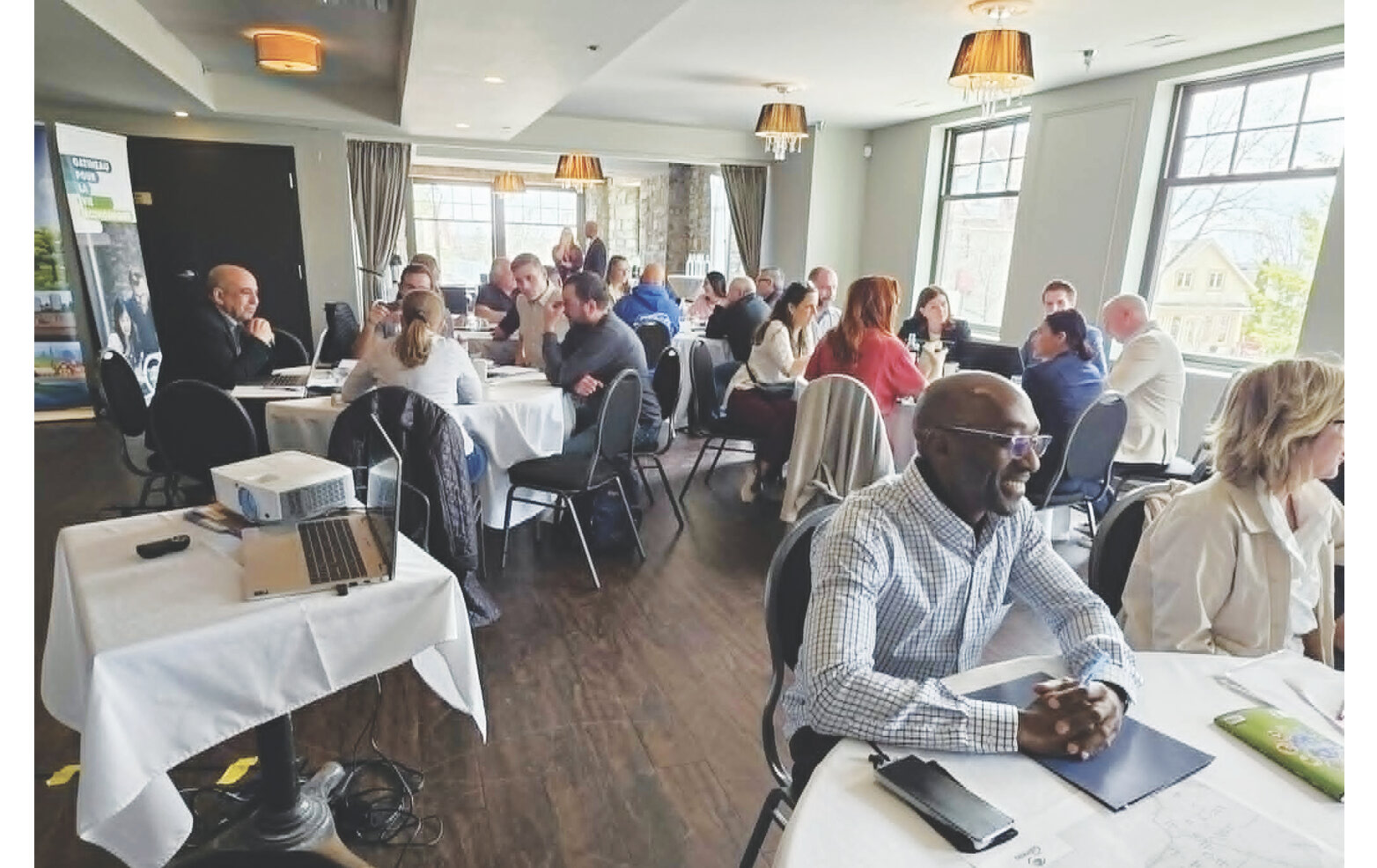
A new consolidated report from planning firm LGP confirms and expands on concerns raised at last April's Aylmer industrial workshop, warning that Gatineau is running out of usable industrial land and losing tax base to residential growth, while laying out ten proposed actions, from naming priority sectors to speeding up permitting, meant to guide the city's next industrial development strategy. Photo: Tashi Farmilo, Aylmer Bulletin archives
City report confirms what Aylmer workshop already showed: Gatineau's industrial base is shrinking
Tashi Farmilo
Gatineau held two public workshops on April 22 and 23, one at the Grand Hangar of Collège Select Aviation at Gatineau Airport, the other at The British in Aylmer, asking manufacturers, developers and community stakeholders to help shape a new industrial development strategy amid warnings that the city is running out of industrial land.
Planning firm LGP, the consultants hired to lead that process, has since released its findings in a document titled "Stratégie de développement industriel: Rapport de consultation publique." It confirms and expands on what was said in Aylmer: the city's industrial land is nearly exhausted, its tax base is quietly shifting onto homeowners, and its economic ambitions have long outpaced its follow-through.
The report blends hard figures with the perceptions participants shared at the tables. Manufacturers, developers and socio-economic partners nonetheless described a common frustration: Gatineau has real assets, its proximity to Ottawa, a skilled workforce, a strong quality of life, but no clear, committed vision for what kind of industrial city it wants to be. Several pushed back against a scattershot approach to development, urging the city to name specific priority sectors, among them advanced technology, the circular economy, construction-related manufacturing and prefabricated building components, agri-food, defence and cybersecurity, and aerospace, and commit to them rather than trying to appeal to everyone at once.
The land and tax figures presented in Aylmer explain the urgency behind that message and form the factual backbone of the report's analysis. Gatineau has grown past 300,000 residents, but nearly all of that growth has been residential. Industry now accounts for just over 10 per cent of employment, against one in four jobs tied to public administration. The industrial and commercial share of the city's standardized property wealth has slid from about 18 per cent in 2019 to 12 per cent in 2025, shifting more of the municipal tax burden onto homeowners. Of the city's 14 industrial parks, usable land is nearly gone, and a prior study found buildings occupy only 19 per cent of the land within them on average, well below comparable cities.
Beyond the numbers, the report devotes real space to softer, harder-to-quantify complaints about how the city functions day to day. Participants described permitting delays, inconsistent processing times and frequent turnover among the staff handling their files, obstacles several said push developers toward more agile neighboring municipalities. The report treats these as perceptions rather than proven facts but notes they surfaced often enough to count as a pattern worth addressing, tying them to Gatineau's lingering reputation as a civil-servant city, one that participants suggested shapes the administration's own appetite for economic risk, not just how outsiders see it.
Distilling the two days of discussion, LGP draws four broader lessons: that Gatineau's potential requires a more decisive vision to become a real strategic lever, that administrative predictability is now a major factor in competitiveness, that traditional zoning models are falling behind the needs of hybrid and flexible businesses, and that optimizing the land the city already has, through densification and reuse, is no longer optional.
The report closes with ten proposed actions for the city: formalize a clear industrial vision, name priority sectors and commit to them, manage industrial land more strategically, streamline permitting and internal coordination, improve predictability in municipal processes, set up standing channels for dialogue with business, adapt zoning to hybrid and flexible business models, prioritize densification and reuse of existing parks over new expansion, plan ahead on infrastructure and energy capacity, and strengthen Gatineau's distinct economic identity and image.